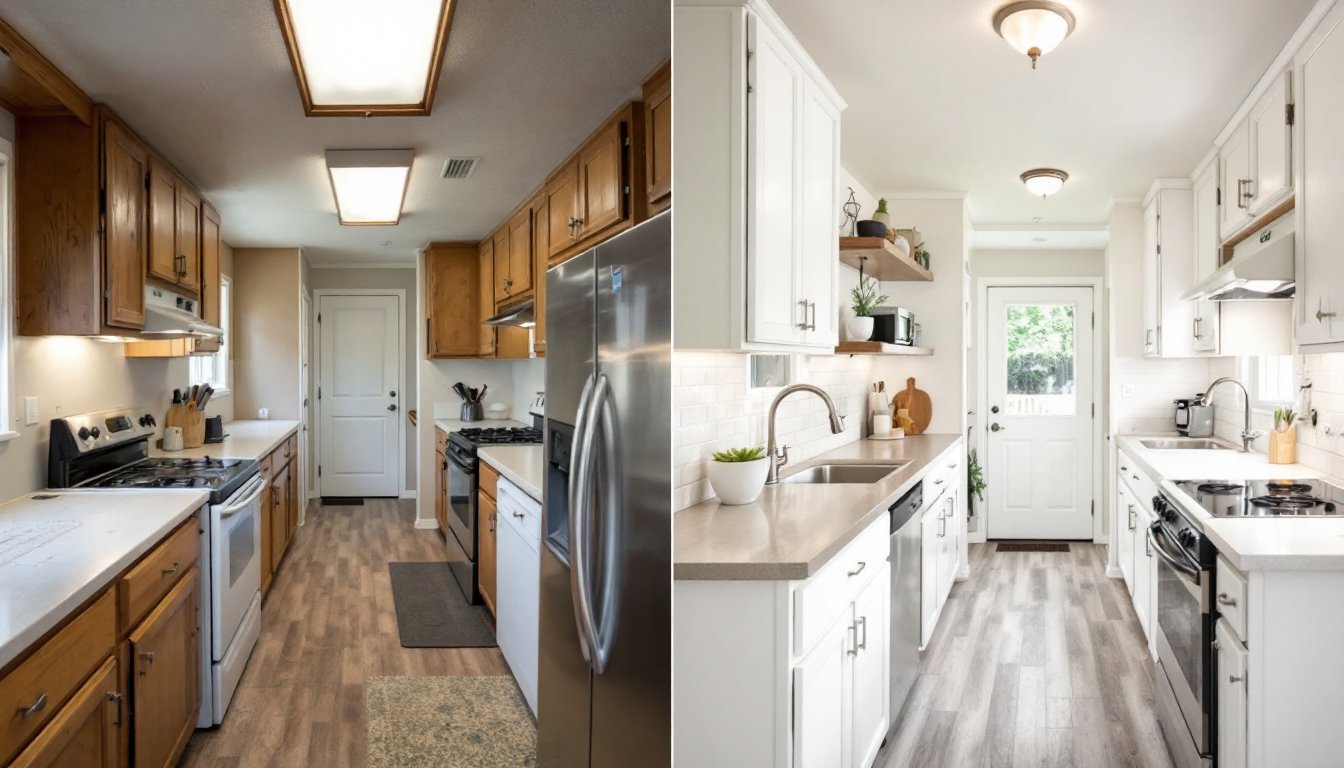
Single wide mobile homes often come with cramped, outdated kitchens that feel like an afterthought. But a targeted kitchen remodel can completely change how the space functions and feels, without gutting the entire home or draining your savings. This guide walks through the priorities, materials, and strategies that deliver real impact in a mobile home kitchen, from smart cabinetry choices to finishes that actually last in tight quarters.
Table of Contents
ToggleKey Takeaways
- A single wide mobile home kitchen remodel typically costs $5,000–$20,000 and delivers transformative results by addressing durability, storage, and usability in compact spaces.
- Focus your budget on the ‘big three’—cabinetry, countertops, and flooring—which have the most impact on both function and aesthetics.
- Choose flexible, moisture-resistant materials like luxury vinyl plank (LVP) flooring and quartz or solid surface countertops that withstand mobile home movement and kitchen moisture exposure.
- Maximize storage in tight layouts using pull-out shelves, corner carousels, soft-close hinges, and under-cabinet LED lighting to create intentional, livable spaces.
- Light cabinetry colors (white, soft gray, natural wood) paired with one accent element keep visual clutter minimal and make small kitchens feel larger and more open.
- Secure cabinetry to backing boards and mobile home framing with lag bolts rather than drywall anchors, and budget $500–$1,000 for professional assessment before structural or plumbing changes.
Why Kitchen Remodels Matter for Mobile Homes
Mobile home kitchens take a beating. They’re compact, typically have single-wall or galley layouts, and the original cabinetry often sags or doesn’t seal properly against moisture. A remodel isn’t just cosmetic, it addresses durability, safety, and daily usability.
Unlike site-built homes, mobile homes deal with subtle flexing over time, so materials need to withstand movement. Plumbing and electrical runs are tighter, making upgrades trickier. But that’s also why improvements here feel transformative. A kitchen that functions well and looks intentional changes how the whole home feels.
Most mobile homeowners see the biggest payoff from projects that tackle storage (always tight), water resistance (critical near sinks and appliances), and efficient appliance placement. Even modest updates, better lighting, fresh cabinetry, updated countertops, shift the space from “just functional” to genuinely livable.
Planning Your Single Wide Kitchen Renovation
Budget and Space Considerations
Budget for a single wide kitchen remodel typically ranges from $5,000 to $20,000, depending on how much you replace and whether you’re doing some work yourself. Painting cabinets instead of replacing them cuts costs in half. Laminate countertops run $300–800: solid surface or quartz runs $1,200–3,000.
Space is the real constraint. Galleys and single-wall layouts mean every appliance and cabinet placement affects traffic flow and usability. Avoid over-sizing the island (if you add one), many single wide kitchens have only 8–10 feet of wall space, so a 24-inch-deep, 4-foot island eats half the room.
Also, mobile home walls are thinner than site-built walls (typically 2×3 studs instead of 2×4), so cabinetry must be securely fastened. Use backing boards where cabinets mount, especially critical for wall cabinets above counters. Don’t just drive screws into drywall: lag bolts into the framing add safety for a small cost.
Budget $500–1,000 for professional assessment if you’re unsure about structural or plumbing moves. It saves money versus discovering problems mid-project.
Essential Kitchen Updates That Make the Biggest Impact
Focus on the “big three”: cabinetry, countertops, and flooring. These account for the look and function of the space. Lighting and fixtures come next.
Cabinetry and Storage Solutions
Cabinet quality is where most single wide kitchens fail over time. Original cabinetry is often particle board with thin veneer: doors sag, hinges strip, and moisture warping is common. Replacing or refacing is worth the investment.
New stock cabinetry (ASKA, Fabuwood) runs $2,000–5,000 for a modest galley kitchen and installs in days. Refacing, keeping the cabinet boxes and replacing doors, drawer fronts, and hardware, costs $1,500–3,500 and works if the boxes are solid. If boxes are warped or water-damaged, replacement is the safer choice.
For storage in tight spaces, pull-out shelves, corner carousels, and vertical dividers for baking sheets transform unused cabinet depth. Soft-close hinges and drawer glides cost slightly more but reduce noise and wear, important in open mobile home layouts where the kitchen is often visible from the living area.
Lighting inside cabinets, especially LED under-cabinet strips, costs $100–300 and makes even a small kitchen feel intentional. Battery-operated options avoid electrical work.
Countertops, Flooring, and Fixtures
Countertops take daily abuse and are very visible. Laminate (like Formica or Wilsonart) is the budget choice: $200–600 installed, durable, and available in 100+ finishes. Seams can harbor water if not sealed properly, though modern products are better.
Solid surface or quartz costs more but handles heat, stains, and moisture better. Quartz runs $40–80 per square foot installed: most single wide kitchens are 20–30 linear feet of counter, so budget $1,500–2,400. Solid surface (like Corian) ranges $35–70 per square foot.
Flooring in mobile homes often flexes slightly, so rigid materials like tile can crack over time. Vinyl plank flooring (luxury vinyl plank or LVP) is ideal: waterproof, warm underfoot, and forgiving of movement. Expect $3–8 per square foot installed. Avoid standard vinyl sheet or thin laminate: they don’t hold up in kitchens with moisture and foot traffic.
For fixtures, a simple pullout or touchless faucet ($150–400) is a game-changer in a galley kitchen, easier to fill pots, easier to clean. Sink choices matter: stainless steel shows water spots but hides stains: composite sinks hide spots but chip. Both last if you’re not rough with them.
Accentuate the remodel with LED puck lights or a small pendant over a sink or eating area. These cost $50–200 each and add personality without major electrical work (battery options exist, though hardwired looks cleaner).
Inspiration From Real Single Wide Kitchen Transformations
Real before-and-afters show what’s possible. Many single wide owners choose an open, light aesthetic to fight the cramped feeling, white or light gray cabinetry, bright countertops, and wide-open shelving in at least one area.
One common win: removing a partial wall (if structural assessment clears it) to open the kitchen to the living room. This doesn’t require a full remodel but immediately makes the home feel larger. Pair it with consistent flooring (same LVP from kitchen through living room) and the effect doubles.
Color palette matters more in tight spaces. Neutral cabinetry (white, soft gray, natural wood tones) with one accent color (a painted island, open shelves with backing, or a tile backsplash) keeps visual clutter down. Busy patterns or dark cabinets in a small space feel heavier.
Real homeowners also appreciate appliance-free countertops. A coffee maker or microwave permanently on the counter eats precious workspace. Under-counter microwaves and appliance garages (closed cabinets that hide small appliances) sound like luxury touches but are practicality in action.
Sources like Houzz and Remodelista have galleries of completed mobile home and small kitchen remodels where you can see before-and-afters and what other owners chose. The Kitchn focuses on practical small kitchen solutions, including storage hacks for tight layouts, many directly apply to mobile homes.
The best inspiration comes from other single wide owners who faced the same constraints. Mobile home forums and Facebook groups often share photos and honest cost breakdowns. What worked for someone with your floor plan (galley, L-shape, single wall) is more useful than a sprawling farmhouse kitchen from a design blog.